|
Posted: April 22, 2009
|
|
New
biosensor for most serious form of Listeria food poisoning bacteria
Source
of Article: http://www.nanowerk.com/news/newsid=10218.php
|
|
(Nanowerk
News) Scientists in Indiana are reporting development of a new
biosensor for use in a faster, more sensitive test for detecting the
deadliest strain of Listeria food poisoning bacteria. That microbe causes
hundreds of deaths and thousands of hospitalizations each year in the
United States, particularly among people with weakened immune systems.
Their study appears in the current issue of ACS’ Analytical Chemistry ("Targeted
Capture of Pathogenic Bacteria Using a Mammalian Cell Receptor Coupled with
Dielectrophoresis on a Biochip").
|
|
(Click here for illustration)
|
|
|
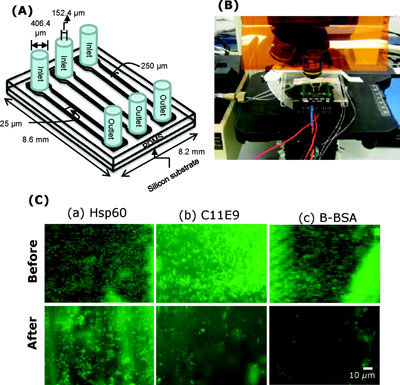
Schematic drawing
(top left) of a microfluidic biochip for capturing Listeria. A prototype
chip, top right, is connected with microfluidic tubings, and at bottom are
images of bacteria on a chip. (Image: The American Chemical Society)
|
|
Arun Bhunia and colleagues note in the new study that fast,
highly effective tests already are available for five of the six known
species of Listeria. These tests use antibodies that signal the presence of
the bacteria. However, no rapid, sensitive tests are available for
detecting Listeria monocytogenes, the deadliest of the species, the researchers
say.
|
|
The scientists describe development of the biosensor using
so-called heat shock proteins — which the body produces in response to
stress — instead of the antibodies used in other tests. They showed that
their new sensor was faster and more sensitive at detecting the deadly
bacterium than antibody-based tests. It had a microbe capture rate up to 83
percent higher than antibody-based tests. The new biosensor will reduce the
likelihood of false-positive results for Listeria monocytogenes and may
lead to improved tests for detecting other types of dangerous pathogens,
the researchers say.
|
|
Source: American
Chemical Society
|
|
|
|
|